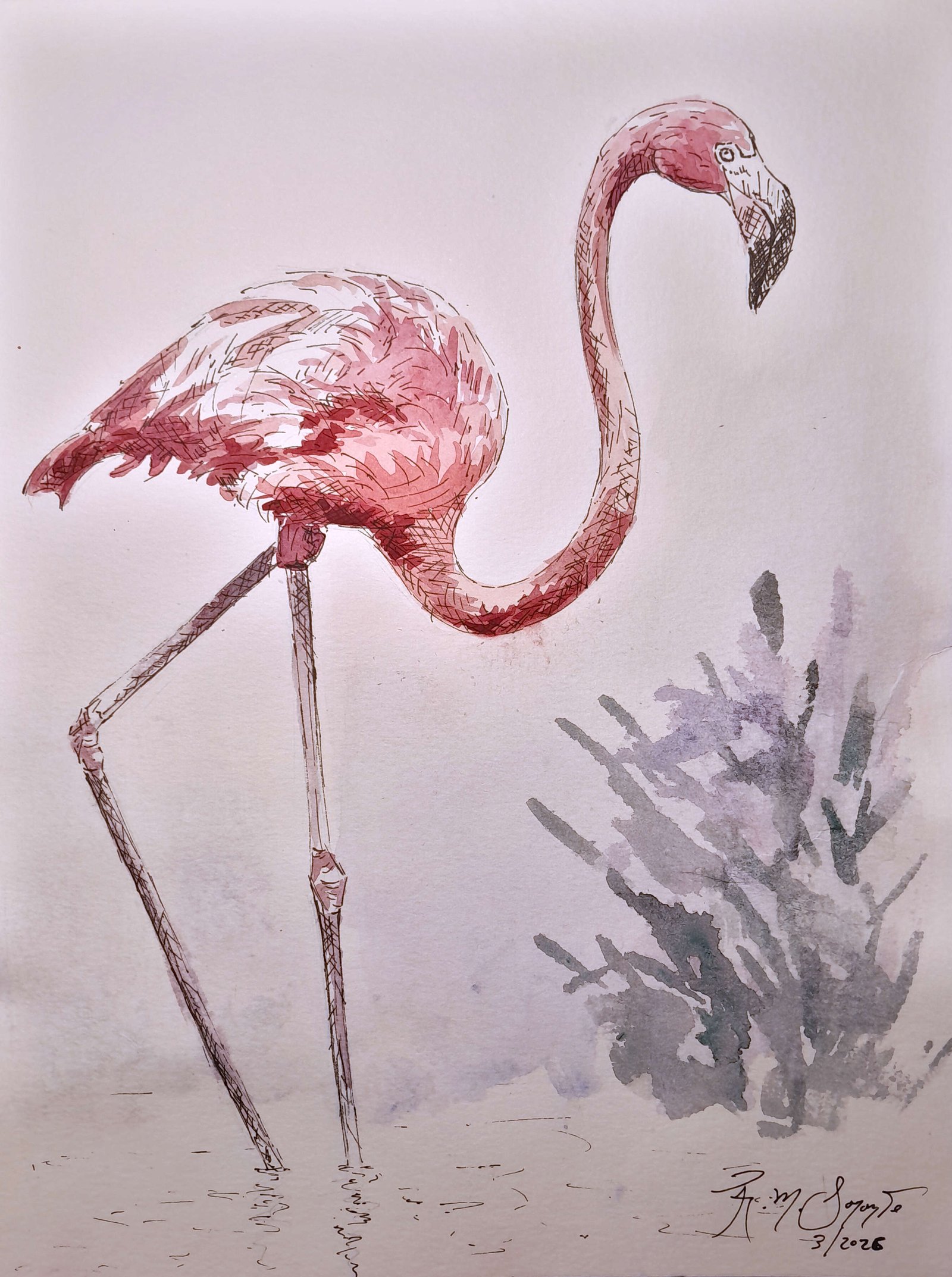
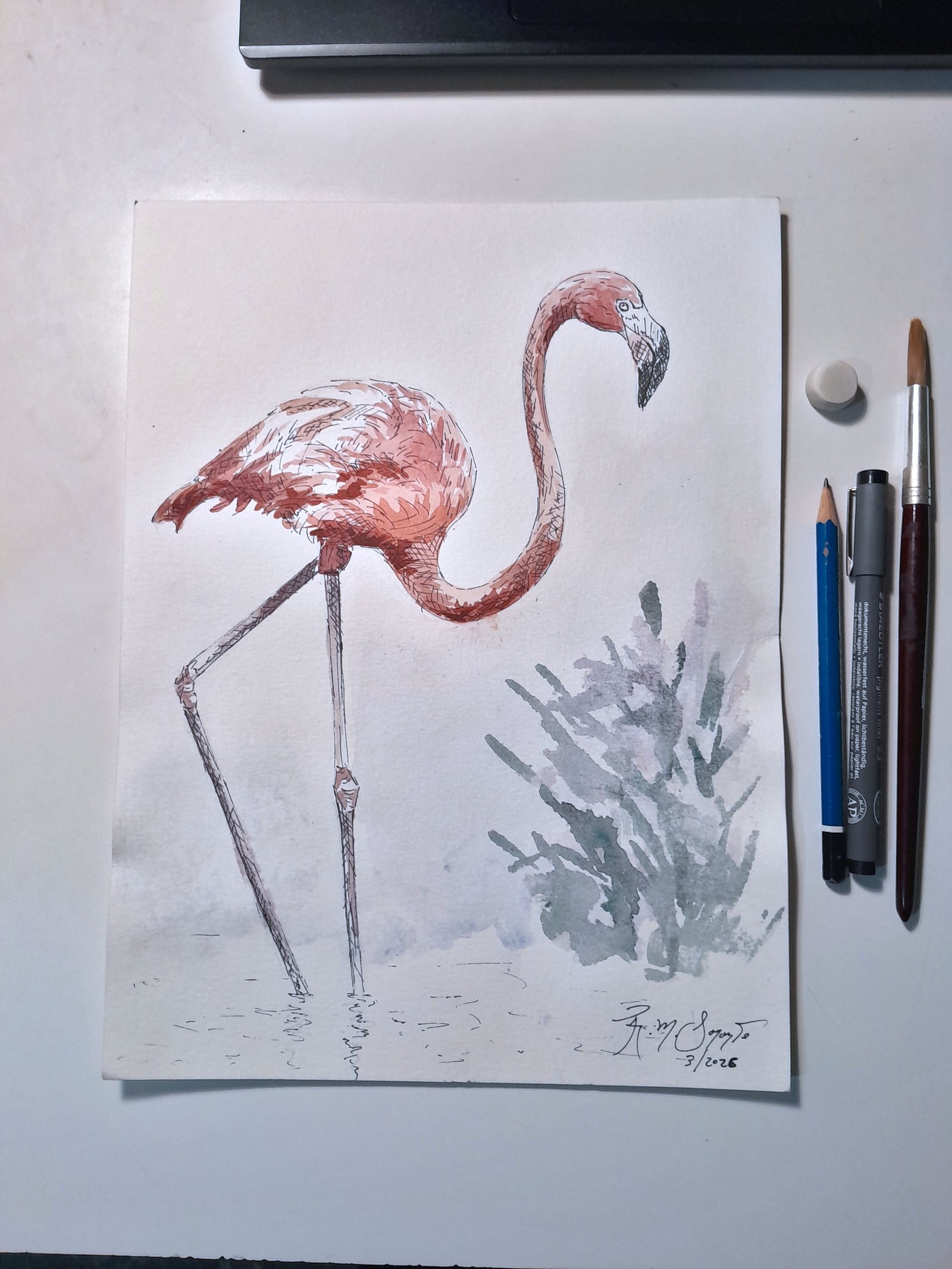
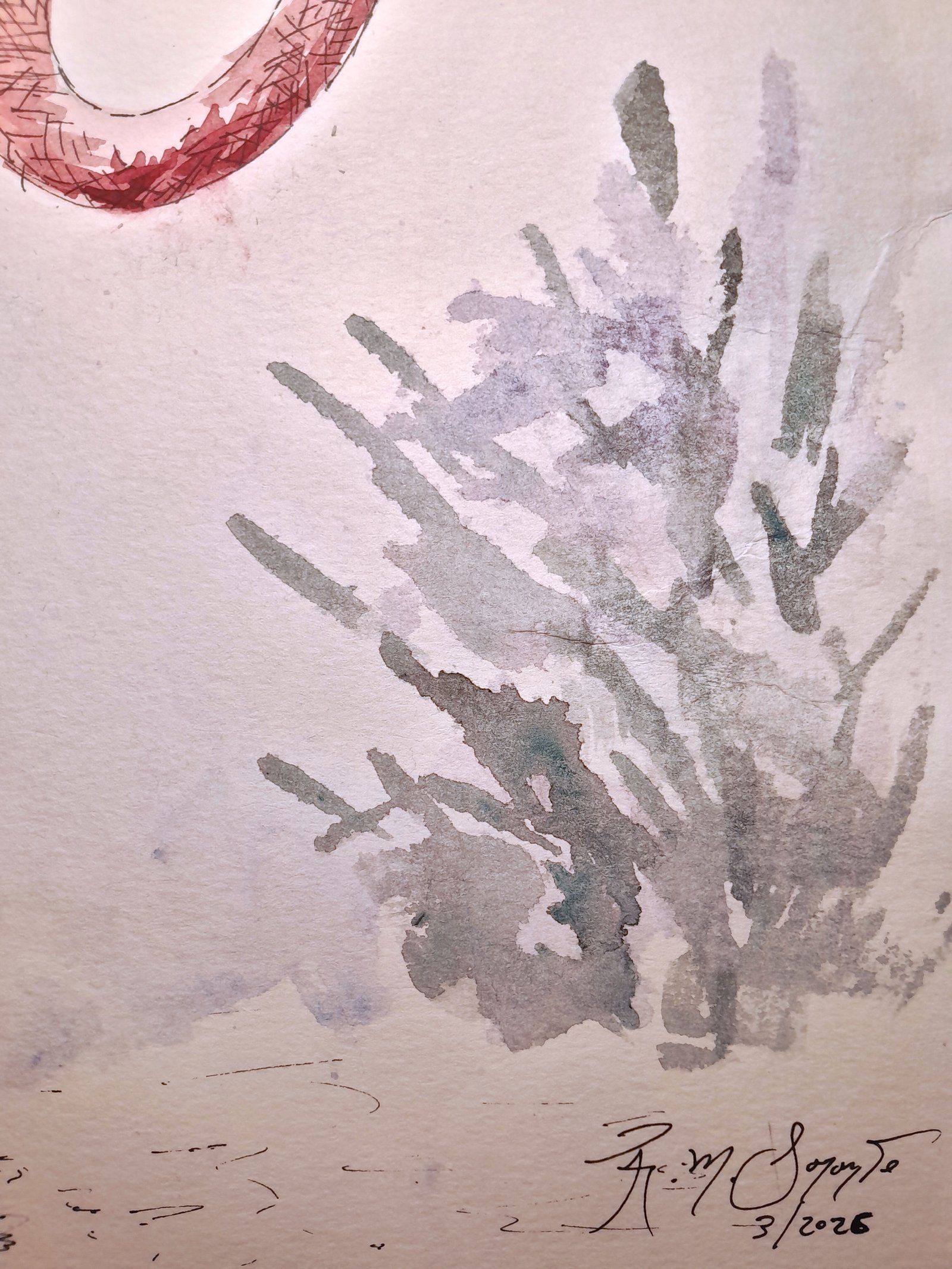
Flamingo No. 1 is a figurative wildlife artwork created with watercolor and technical pen on 300 gsm paper. The composition presents a solitary flamingo standing in shallow water, its elongated body, legs, and characteristic curved neck occupying most of the vertical format. The bird is positioned slightly toward the left and center of the composition, while a loosely painted cluster of aquatic vegetation occupies the lower-right area. Large expanses of unpainted paper surround these elements, giving the scene an open and atmospheric quality.
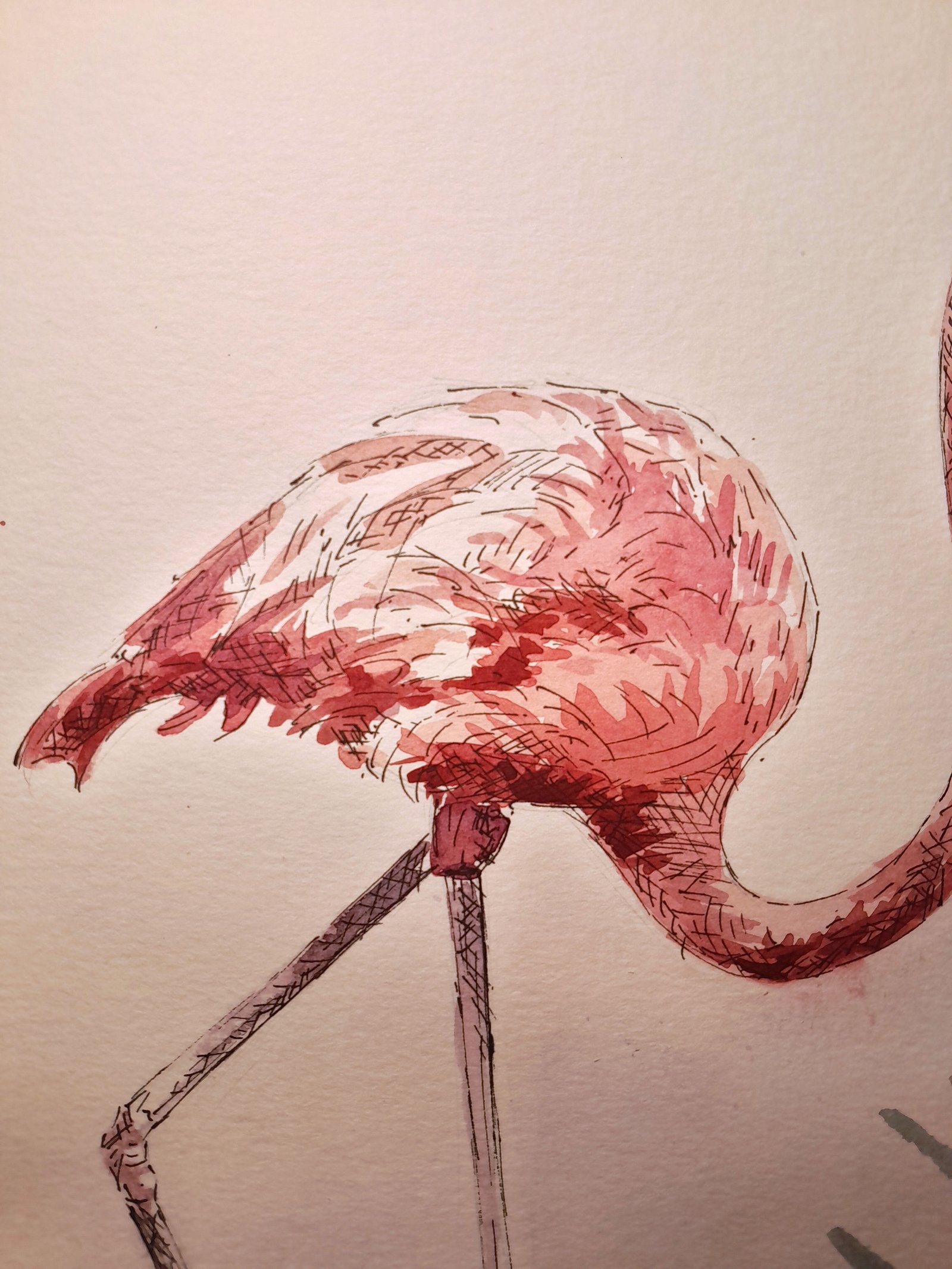
The flamingo is depicted in profile facing right. Its rounded body is covered with overlapping watercolor washes ranging from pale pink and salmon to coral and deeper reddish tones. Areas of untouched or lightly painted paper remain visible among the colored passages, creating highlights and suggesting the layered structure of the plumage. Fine technical pen strokes follow and intersect the watercolor shapes, defining individual feather directions and adding texture to the body and folded wing. Denser cross-hatching appears in the darker portions of the plumage, particularly along the underside of the body and near the tail.
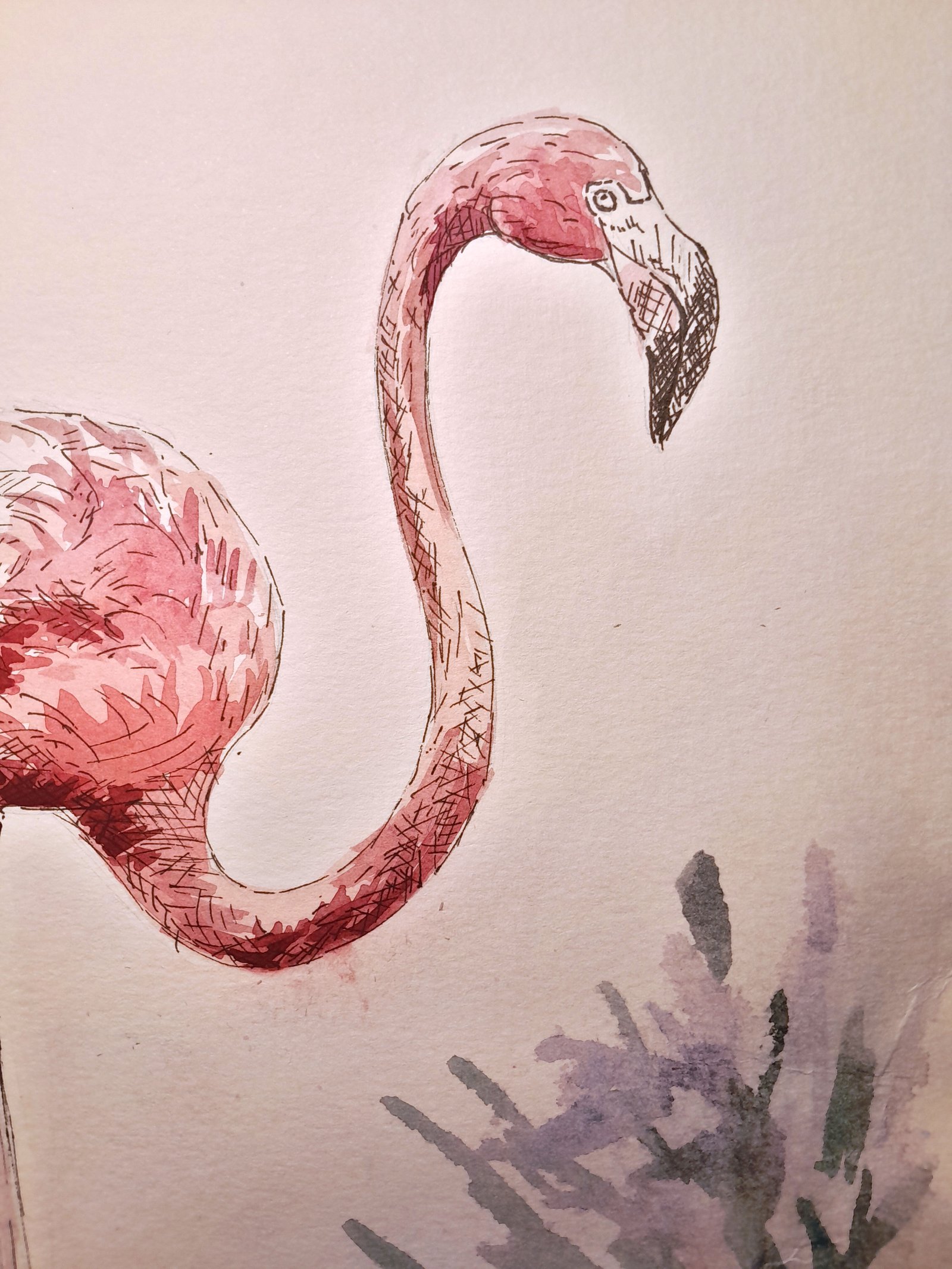
From the body, the neck descends in a broad curve before rising upward toward the head, creating the distinctive S-shaped silhouette associated with the flamingo. Pink and reddish watercolor washes follow this curvature, while fine technical pen hatching reinforces the cylindrical form and introduces areas of shadow. The contrast between the sweeping contour of the neck and the relatively open background makes this feature one of the principal visual elements of the composition.
The head is comparatively small and delicately rendered. A circular eye is surrounded by precise technical pen lines, while the bill curves downward into a pronounced hooked shape. The upper portion of the bill remains relatively light, contrasting with the densely cross-hatched dark tip. This concentration of linework provides a visual focal point at the upper-right end of the bird’s extended neck.
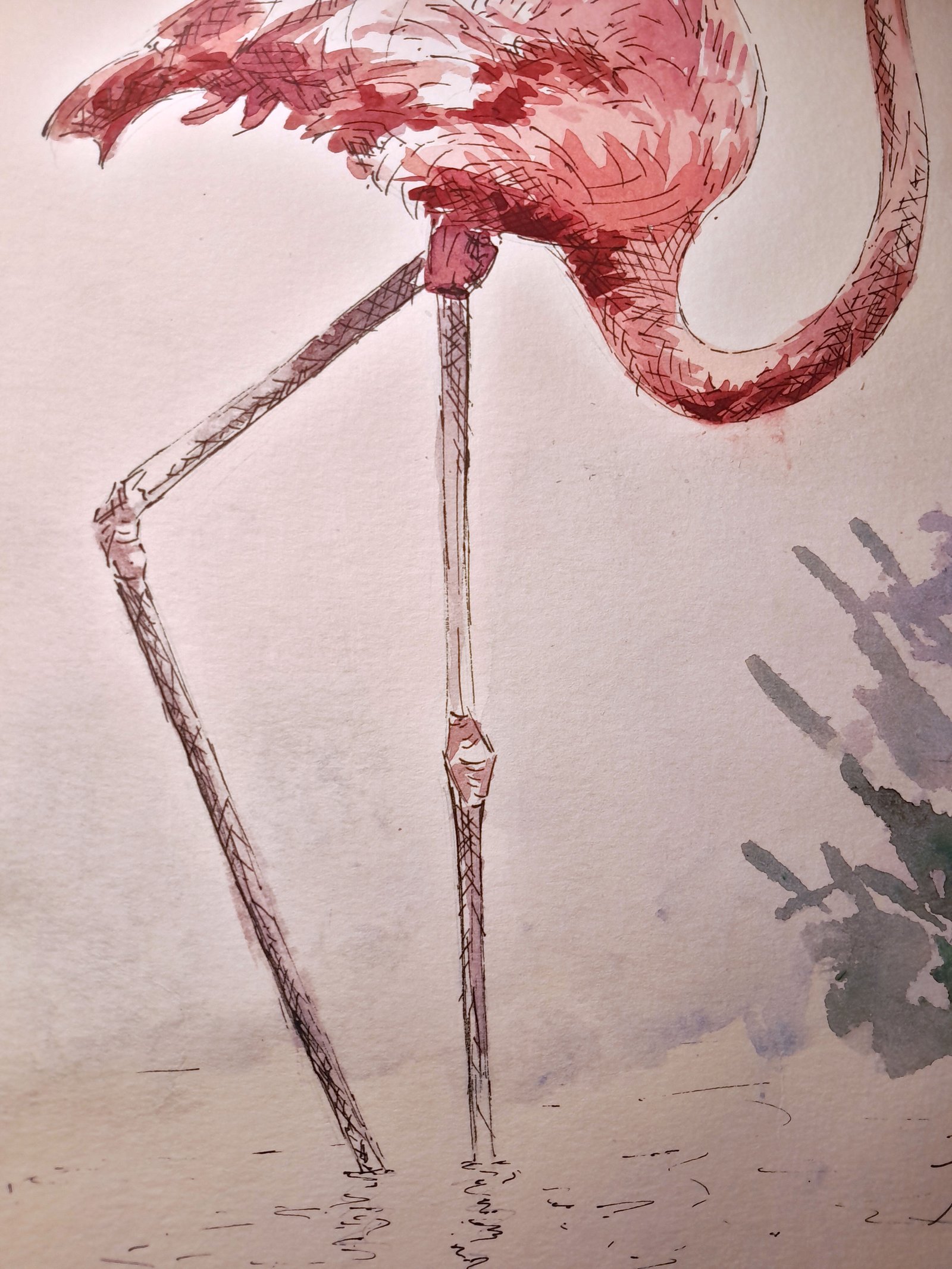
Two exceptionally long and slender legs descend from the body toward the shallow water. One remains almost completely straight, while the other bends prominently backward at the joint before extending downward. Technical pen contours and cross-hatching define the narrow structure of the legs and emphasize the angular articulation of their joints. Small irregular lines beneath them indicate contact with the water and create subtle reflections and ripples.
The surrounding environment is treated much more loosely than the flamingo itself. Pale watercolor washes spread across the lower portion of the paper, suggesting shallow water without establishing a rigid horizon or detailed landscape. Sparse technical pen marks across this area evoke gentle surface movement and reflections. This restrained treatment allows the bird to remain the dominant subject.
On the lower-right side, an abstract cluster of aquatic vegetation introduces a contrasting group of cool colors. Translucent gray, muted violet, blue-gray, and subdued green watercolor marks overlap to suggest reeds, leaves, and wetland plants. Rather than being individually outlined, these forms are largely created through spontaneous brushstrokes and variations in watercolor transparency. Their irregular vertical and diagonal shapes counterbalance the flamingo positioned on the opposite side of the composition.
The artwork combines two distinct visual languages. Technical pen provides structural definition through outlines, hatching, cross-hatching, and small descriptive marks, while watercolor introduces softness, transparency, tonal variation, and organic irregularity. In the flamingo, both media are closely integrated: watercolor establishes the principal masses of color while pen marks articulate feathers, anatomical forms, and shadows. In the surrounding vegetation and water, watercolor becomes more dominant and fluid.
The extensive use of negative space contributes significantly to the composition. Instead of filling the background with environmental detail, the natural tone and texture of the 300 gsm paper remain visible across much of the work. This openness isolates the flamingo and emphasizes its distinctive silhouette, particularly the contrast between its rounded body, elongated legs, and gracefully curved neck.
Flamingo No. 1 focuses on the recognizable anatomy, coloration, and elegance of the flamingo while maintaining the immediacy of a watercolor-and-ink study. The combination of detailed linear drawing and spontaneous washes creates a balance between anatomical observation and expressive interpretation. The artist’s handwritten signature and the date 3/2026 appear in the lower-right corner beneath the vegetation.